
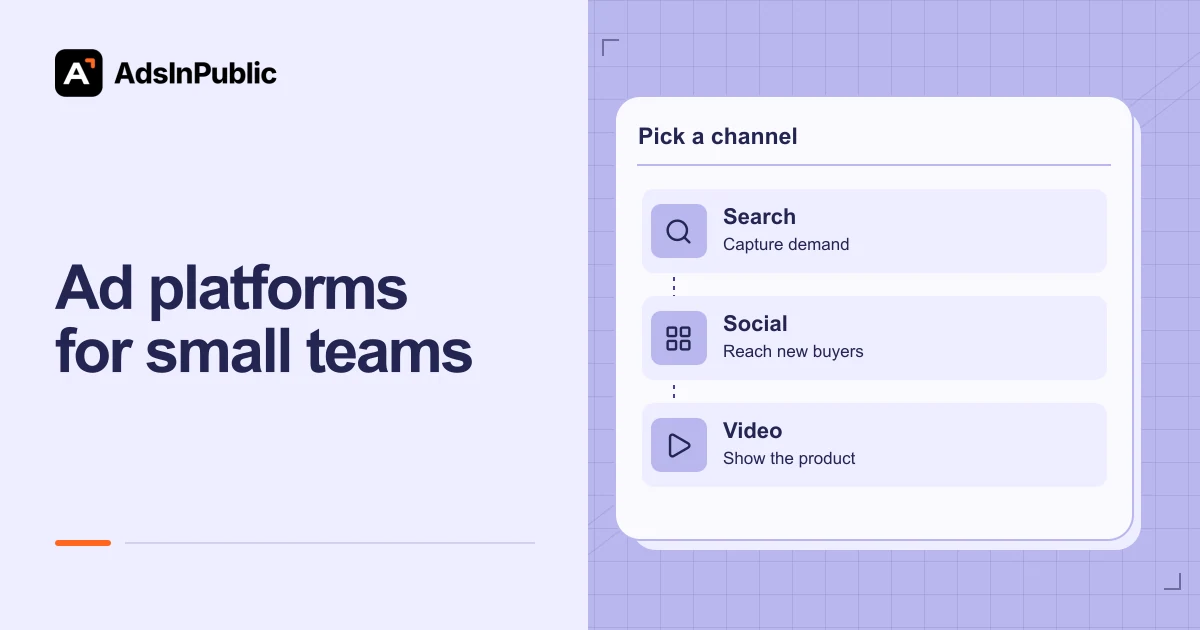
Choose an ad platform by where your customers spend time and what you can afford to learn. The ten options here include Google Ads, Meta (Facebook and Instagram), TikTok, LinkedIn, Reddit, YouTube, Microsoft Ads, Yelp, Nextdoor and Pinterest. Compare their budget floors, targeting and billing before you commit. A $300 monthly budget can teach you more on one well-chosen channel than it can spread across six.
The 10 platforms at a glance
| Platform | Best for | Verified budget floor | Where ads appear |
|---|---|---|---|
| Google Ads | Businesses customers search for | No published minimum; budgets are daily averages | Search, Maps, YouTube, Display, Gmail |
| Meta (Facebook + Instagram) | Visual consumer products, local services | Variable minimums; $5/day widely cited as a starting point | Feeds, Stories, Reels, Marketplace, Threads |
| TikTok | Impulse-friendly, visual products | Campaign >$50/day; ad group >$20/day | In-Feed, Top Ads-verified placements |
| B2B services and high-ACV offers | $10/day; $100 lifetime minimum | Feed, inbox, communities | |
| Niche products with clear communities | $5/day | Home, Popular, community feeds, conversations | |
| YouTube | Demonstrations and brand building | No published minimum; ~$0.10–$0.30 CPV | Skippable/in-stream, Shorts, in-feed |
| Microsoft Ads | Search demand beyond Google | ”No minimum fee” | Bing, Yahoo, DuckDuckGo, Edge, Outlook |
| Yelp | Local services with high intent | ”As little as $5/day on average” | Yelp search results, competitor pages |
| Nextdoor | Neighborhood businesses | Not publicly listed | Local feeds via Ads Manager |
| Products people plan and shop for | ”Set your own budget” | Feeds and search with shopping features |
1. Google Ads: where demand already exists
If customers search for what you sell, Google is the first platform to fund: search ads put you in front of people actively typing the need, with keyword-level visibility no other channel matches. Budgets are average daily amounts (Google may spend up to 2× on a busy day, capped monthly at 30.4× the average (Google’s overdelivery documentation)), and Google sets no published minimum budget. The catch for small businesses is data: conversion tracking must be live before spend, and underfunded campaigns struggle to feed Smart Bidding. For search demand that exists today, nothing else on this list captures it.
2. Meta: the default for visual consumer products
Facebook and Instagram ads work when creative is native and signal is clean. Verified mechanics: minimum budgets vary by country, objective, and bid strategy, with an in-tool alert as the source of truth and a 5× cost-per-result guideline for cost-per-result bidding (Meta’s minimum-budget guidance); an ad set usually exits learning only after “about 50 results in the week after the ad set’s last significant edit” (Meta’s learning-phase documentation). Threads joined the placement lineup globally in 2026. Meta suits products and services people discover while scrolling, such as fashion, gadgets, home goods and local services. Give Advantage+ reliable conversion data so it can optimize delivery.
3. TikTok: impulse discovery with real floors
TikTok’s auction is built for creative-first discovery, and its floors are published: campaign daily budgets must exceed $50 and ad-group budgets exceed $20, with delivery pausing when budgets are hit (TikTok’s budget documentation). Creative carries the targeting. TikTok’s own guidance calls for native, unpolished vertical video with the hook in the first six seconds (TikTok’s creative best practices). Note for Indian businesses: TikTok has been banned in India since June 2020 and remains blocked. The platforms to watch there are Instagram Reels and YouTube Shorts instead (BBC’s account of the ban).
4. LinkedIn: B2B offers with the margin to pay for precision
LinkedIn is the only mainstream platform targeting by verified member attributes (job title, seniority, company size) with verified floors of $10 daily and $100 lifetime minimum budgets, and suggested $25/$50–100 defaults (LinkedIn’s budget guidance). Clicks cost more than anywhere else on this list. A 2025 study of 138 B2B advertisers put the median cost per raw lead at $376 (metadata.io’s benchmark), so the platform pays back only when your deal value absorbs expensive, partly unqualified demand. For local B2C businesses, skip it; for consultants, agencies, and B2B SaaS, nothing else targets the buyer directly.
5. Reddit: niche communities at the lowest floor
Reddit’s $5-per-day minimum (“this must be $5 or greater” per its Get Started documentation (Reddit’s Get Started guide)) makes it the cheapest real test on this list. Community targeting reaches users active in specific subreddits within a 28-day window, with Reddit advising at least 15 communities per ad group (Reddit’s audience guide), and its users respond to honesty and punish corporate cosplay. For hobby products, niche tools, and anything with a natural subreddit home, Reddit’s auction is the least competitive on this list.
6. YouTube: demonstration and brand demand
YouTube ads run through Google Ads with per-view pricing: skippable in-stream ads bill only when viewers watch 30 seconds or interact, and third-party benchmarks put average CPVs at $0.10–$0.30 (WordStream’s advertising-costs guide). That billing model makes YouTube unusually forgiving of a small budget. You pay for engaged views, not raw impressions. It’s the right platform when your product needs to be seen working: demos, before/after, education. The 5-second skip rule means branding and the hook must land immediately (Google’s video ad requirements policy).
7. Microsoft Ads: Google’s search demand at lower competition
Microsoft Advertising’s own pitch: search ads across “Bing, Yahoo, DuckDuckGo, and other search engines,” display across Microsoft 365, MSN, Edge, and Outlook, connected TV spanning Netflix, Max, Hulu, Roku, and discovery+, Copilot-assisted ad asset creation, and “No minimum fee” and “only pay for clicks” (Microsoft Advertising). The audience skews older and more desktop-bound than Google’s, with generally less competition per keyword. As a second search channel once Google Ads is proven, it’s the cheapest incremental reach in search.
8. Yelp: high-intent local services
Yelp Ads put businesses in “Sponsored Results” sections above and below organic search results and on competitor pages, with “as little as $5/day on average” as the stated floor, adjustable budgets, and no term contracts for self-serve advertisers (Yelp’s advertising page). Yelp’s 4×-more-leads claim is the vendor’s own (treat it as directional), but the intent quality is structural: people searching Yelp are choosing a provider, not browsing. For restaurants, home services, salons, and clinics, it’s the only platform on this list where the ad sits between the customer and a decision.
9. Nextdoor: neighborhood-level reach
Nextdoor reports more than 100 million verified users across 11 countries and 340,000+ neighborhoods, with targeting by homeownership, household income, and other household attributes (Nextdoor for Business). Pricing and minimums aren’t published on its site (you’ll see requirements in Ads Manager), so treat it as a test budget rather than a plan. Its edge is hyper-local: the only platform where a five-mile radius is the natural targeting unit, which fits realtors, contractors, cleaners, and local retail in a way no national feed can.
10. Pinterest: planned purchases and shopping intent
Pinterest’s own positioning: “the No. 1 reason people use Pinterest is to find new products and brands,” with ads that enhance rather than interrupt the browsing experience, free business accounts, and “you can set your own budget if you decide to run ads” (Pinterest for Business). No minimum budgets are published. Pinterest’s fit is specific: home, fashion, food, wedding, and DIY purchases that people plan in advance. The platform functions as visual search with shopping built in, and its users arrive with purchase intent most social feeds lack.
How to choose two platforms (not ten)
The small-business failure mode is spreading $500 across six platforms. The working pattern: one intent platform (Google if demand is searched, Yelp if local services, Microsoft as the budget variant) plus one discovery platform (Meta or TikTok for visual products, Reddit for niches, Pinterest for planned purchases, Nextdoor for hyper-local). Fund both above their learning thresholds, judge each on a full learning cycle, and only add a third platform after the first two have proven economics. That’s the structure that survives into 2027 regardless of which features the platforms ship.
Frequently asked questions
Which platform is cheapest to start on? Reddit’s $5/day floor and Yelp’s $5/day average are the published entry points; Microsoft Ads states “no minimum fee”; Google and Pinterest publish no minimum; Meta’s minimums vary by account. But the honest answer is that the cheapest platform to start is rarely the cheapest to learn. Each algorithm needs enough volume to optimize, so budget to the learning threshold, not the floor.
What will change for these platforms in 2027? Plan around the features you can use now. Meta’s Advantage+, Google’s Smart Bidding, Microsoft’s Copilot assets and TikTok’s Smart+ already automate parts of campaign setup or delivery. Verify conversion tracking and make creative for each placement so those tools have useful data and ads to work with.
Should a small business hire an agency or run ads in-house? In-house first at small budgets: every platform’s self-serve floor ($5–$50/day) is lower than most agency minimums, and learning the dashboard is a durable asset. Agencies earn their fees when spend is large enough that optimization percentage gains outpace their retainer (commonly in the four-figure monthly range) or when the owner’s time is worth more elsewhere.
How much should a small business spend on ads in total? Enough to reach the learning threshold on one or two platforms. For context, Meta’s learning rule implies an ad set needs roughly 50 optimization events per week, so divide 50 by 7 and multiply by your expected cost per result. A $300–$1,000/month budget concentrated on two platforms will outperform $2,000 scattered across six, because concentration is what turns ad data into decisions.
Sources and references
Budget and targeting details reflect platform documentation from November 2026.
- Google Ads Help: About overdelivery and your average daily budget. Daily budgets as averages, 2× daily overdelivery, 30.4× monthly cap.
- Meta Business Help Center: Best practices for minimum budgets. Variable minimums, in-tool alerts, 5× cost-per-result guideline.
- Meta Business Help Center: About the learning phase. ~50-results-per-week exit threshold; edit resets; “Learning limited.”.
- TikTok Ads Manager: About budgets for ads. Campaign >$50/day, ad group >$20/day floors.
- TikTok Ads Manager: Creative best practices. Hook timing, native style, 3–5 creatives per ad group.
- BBC Future: The ghosts of India’s TikTok. India’s June 29, 2020 ban and its persistence.
- LinkedIn Marketing: Best practices for budgets. $10/day and $100 lifetime minimums; $25/$50–100 suggested defaults.
- metadata.io: LinkedIn Ads cost benchmark. 2025 study of 138 B2B advertisers; $376 median cost per raw lead.
- Reddit Ads Help: Get Started. “$5 or greater” daily budget floor.
- Reddit Ads Help: Reddit audiences. Community targeting, 28-day window, 15-communities guidance.
- WordStream/LocaliQ: Online advertising costs. YouTube CPV $0.10–$0.30, CPC $0.50–$3.00, CPM $4–$10.
- Google Ads policy: Video ad requirements. Skippable/non-skippable rules and branding requirements.
- Microsoft Advertising. Bing/Yahoo/DuckDuckGo search reach, Copilot asset generation, “No minimum fee.”.
- Yelp: Yelp Ads. $5/day average floor, no term contracts for self-serve, sponsored results and competitor-page placement.
- Nextdoor for Business. 100M+ verified users, 11 countries, household targeting; no public pricing.
- Pinterest for Business. Product-discovery positioning, free business accounts, self-set budgets.