
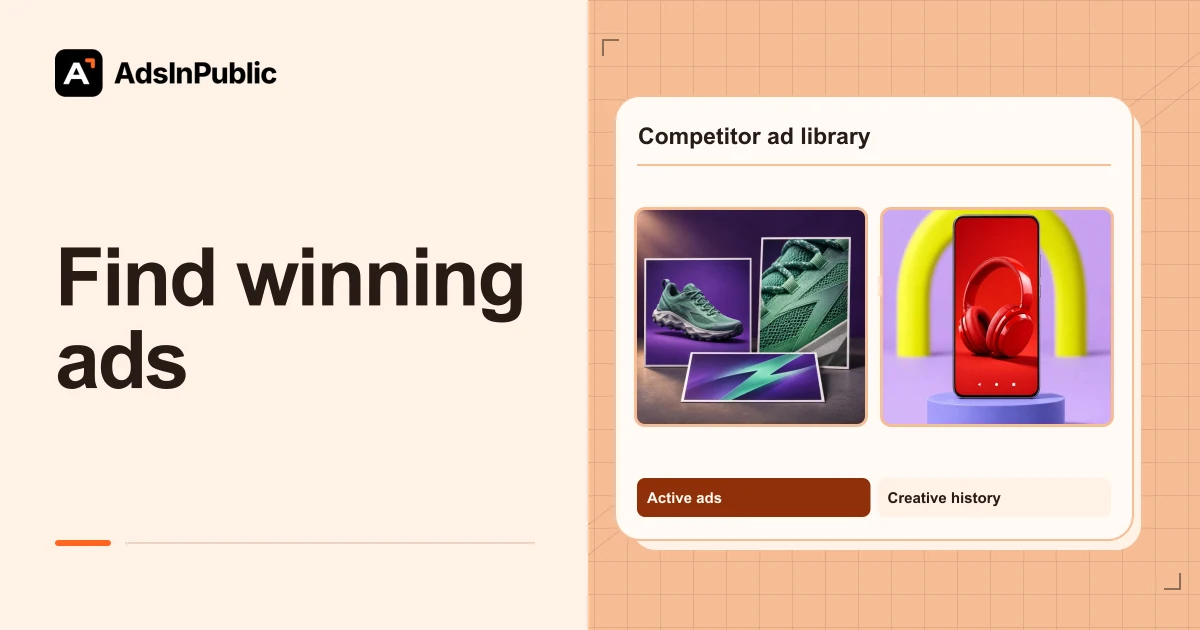
Start with the free ad libraries from Meta, Google, TikTok and LinkedIn to see which ads your competitors are running. A paid tool can add cross-network search, longer ad history, landing-page archives and launch alerts. SpyFu covers Google search history, Foreplay helps teams organize creative research, BigSpy and PowerAdSpy offer broad social coverage, and Adbeat specializes in display and native ads. A long-running ad can suggest what to test. You’ll need results from your own campaigns to judge the idea.
The 10 tools at a glance
| Tool | Best for | Verified price | Coverage |
|---|---|---|---|
| Meta Ad Library | Live Meta ads, free | Free | Facebook, Instagram, Messenger, Threads |
| Google Ads Transparency Center | Search/YouTube ads, free | Free | Ads served through Google’s network |
| TikTok Creative Center Top Ads | TikTok creative benchmarks, free | Free | TikTok auction ads |
| LinkedIn Ad Library | B2B ads, free | Free | LinkedIn ads since June 2023 |
| SpyFu | Google search-ad history | $39–$249/mo | Google search ads, keywords |
| BigSpy | Broad social coverage, budget tiers | $49–$399/mo (promo) | 11 networks |
| Adbeat | Display and native intelligence | $249–$399/mo | 151 display networks, 35 markets |
| Foreplay | Creative workflow + competitor tracking | $49–$459/mo (annual) | Meta, TikTok, LinkedIn, Google libraries |
| PowerAdSpy | Multi-network social search | $69–$399/mo | 11 networks |
| Anstrex | Native, push, and TikTok ads | $39.99–$89.99/mo per product | Native, push, pops, TikTok |
The free official libraries: start here
Meta Ad Library. Meta describes it as “a comprehensive, searchable database of ads that are currently running on Facebook, including Instagram” (Meta Transparency Center). You can search by keyword or advertiser and see every active ad a brand is running, the primary source for what competitors are doing right now on Meta, with no subscription. Limitations: it shows active ads with limited history (political ads are archived; commercial ads generally aren’t in depth), and it doesn’t sort by performance.
Google Ads Transparency Center. Google’s advertiser-verification documentation states plainly that “people can search for an advertiser and check info about the advertiser and their ads,” with ads served on platforms like Search and YouTube findable in the center at adstransparency.google.com (Google’s advertiser verification documentation). Search by advertiser or domain, then filter by region and date to see the advertiser’s Search and YouTube ads.
TikTok Creative Center Top Ads. TikTok’s own showcase of “high-performing auction ads,” filterable by region, objective, ad language, and format, sortable by reach and CTR (TikTok Creative Center: Top Ads). This is the only TikTok tool that comes with platform-side performance signals (reach and click-through sorting), which third-party TikTok spy tools can’t replicate.
LinkedIn Ad Library. A “publicly available database” of ads that ran on LinkedIn after June 1, 2023, searchable by company, payer, keyword, country, and date, with ads retained for a year after their last impression (LinkedIn’s Ad Library documentation). For B2B marketers it’s the fastest read on how competitors frame offers on LinkedIn, including payer-of-record details that social libraries hide.
The paid tools
1. SpyFu: Google search-ad history
SpyFu’s edge is depth of search-ad history: all plans include “10+ years of historical data” and pre-built Google Ads campaign outlines (SpyFu pricing). Verified plans: Basic $39/month ($29 annual; 10k-row search limits), Pro + AI $119/month ($89 annual; “unlimited search results,” 10 live site-tracking projects, API credits), Team/Agency $249/month ($187 annual; white-labeled reporting, API, 5 users). If your competitors run Google Search ads, SpyFu shows the keywords they’ve bid on and the ad copy they’ve tested for a decade, intelligence the Transparency Center shows only as a snapshot.
2. BigSpy: broad social coverage with a real free tier
BigSpy covers 11 ad platforms (Facebook, Instagram, Google Ads, YouTube, TikTok, X, Pinterest, Yahoo, Unity, Pangle, AppLovin) with Facebook included on every plan (BigSpy pricing). Verified tiers: Free (10 searches/day), Starter $69/month ($49 with the November 2026 promotion), Growth $159 ($119), Scale $399 ($299, 5 seats), Ultimate $499 ($399), with Google/YouTube/TikTok access starting at the Growth tier. The free tier and day-limited search quotas make it the easiest way to test whether a spy tool earns its keep before committing.
3. Adbeat: display and native intelligence
Adbeat is the display-native pick: coverage “across 151 of the most important display networks, DSPs and exchanges,” plus 31 native networks and 35 markets (Adbeat pricing). Verified tiers: Standard $249/month (90 days of data, publisher placement URLs, 200 downloadable reports), Advanced $399/month (unlimited results, one year of data, Direct Buys, competitor alerts), Enterprise custom (estimated ad spend, 3 years of data). If your competitors’ traffic comes from display and native placements rather than social feeds, Adbeat shows the publisher relationships the social spy tools can’t see.
4. Foreplay: spy data turned into creative workflow
Foreplay wraps ad-intelligence features inside a creative workflow: a swipe file with a Chrome extension, Discovery search across “over 200m ads,” Spyder competitor tracking (24/7 Meta tracking with up to 3 years of history), Lens creative analytics connecting Meta and TikTok ad accounts, and AI-powered briefs (Foreplay pricing). Verified tiers: Basic $59/month ($49 annual, 1 user), Workflow $175 ($149 annual, 5 users), Agency $459 ($389 annual, 10 users), with a 7-day free trial. It’s the pick for agencies whose deliverable is the ad itself. The same inspiration pipeline runs from competitor tracking to an AI-drafted brief.
5. PowerAdSpy: multi-network search with cheap trials
PowerAdSpy advertises “all 11 networks, one platform”: Facebook, Instagram, Google (Search and Display), YouTube, native ads, Reddit, Quora, Pinterest, LinkedIn, and TikTok (PowerAdSpy pricing). Verified tiers: Basic $69/month (Facebook and Instagram), Standard $99 (adds Pinterest and GDN), Platinum $279 (adds YouTube, native, Google Search), Palladium $399 (all networks), with $1–$7 three-day trials and steep annual discounts (Basic to $27/month). The trials are genuinely cheap (cancel before day three), which makes it a low-risk way to test multi-network spying.
6. Anstrex: native, push, and TikTok coverage
Anstrex sells per-product intelligence rather than bundles: Anstrex Native at $79.99/month for native ad campaigns, Anstrex InStream at $39.99/month described as “a large TikTok ads library,” Anstrex Push at $89.99/month, and Anstrex Pops at $89.99/month (Anstrex). It also ships dropshipping integrations (Shopify, WooCommerce, AliExpress product importing) and landing-page deployment. For media buyers working native and push traffic (channels the social-first spy tools barely touch). It’s the established specialist.
What happened to MagicBrief?
MagicBrief shut down on July 31, 2026, and its team joined Canva to build Canva Grow (MagicBrief). If an older comparison recommends MagicBrief, start with the free ad libraries or check whether a paid tool still offers the features you need.
How to use competitor ad data
Look at which offers and creative ideas competitors keep running, then use those patterns to plan your own tests.
- Run duration beats cleverness. An ad that has run for months on the same angle is the closest proxy to a winner you can get from the outside. Sort libraries by longest-running, not newest.
- Count the variants. A competitor running 30 variants of one hook is telling you what’s working; their newest ad is just their newest guess.
- Check the landing pages. The ad is the smallest half of the funnel. SpyFu, Foreplay’s Spyder, and Adbeat all archive destination pages; the offer and page structure you find there usually explain the ad.
- Look for patterns. Copying a competitor’s ad verbatim is both ineffective (the algorithm has already attributed that creative to them) and legally risky (trademark and copyright still apply). Extract the structure (hook type, offer framing, format) and rebuild for your product.
Reading the data: what each channel reveals
The channel you spy on determines the lesson available. Search ads (SpyFu, Google’s Transparency Center) reveal demand language: the keywords a competitor pays for and the copy angles they’ve tested across years are essentially a free map of what converts on intent. Social feeds (Meta Ad Library, BigSpy, PowerAdSpy) reveal creative strategy: variant counts, hook structures, format mix, and how fast a competitor cycles creative tell you their testing velocity and their current best guesses. Display and native (Adbeat, Anstrex) reveal the business model: publisher placements, direct-buy relationships, and landing-page funnels show where a competitor’s economics actually work, since display buying is unforgiving of weak offers. B2B (LinkedIn Ad Library) reveals targeting and spend posture: payer-of-record details and run dates tell you whether a competitor is testing lightly or committed to a segment. Match the tool to the question you’re actually trying to answer, not to whichever one has the flashiest dashboard.
Frequently asked questions
Are ad spy tools legal? Using public ad libraries and ad-intelligence services to view competitors’ ads is standard practice, and the platform-run libraries exist precisely for transparency. The legal lines are elsewhere: don’t infringe trademarks or copyrights by copying creative, and respect each platform’s terms when using automated collection. Scraping beyond a service’s terms is a contract issue, not a research one.
Can I see how much a competitor spends on ads? Generally no, and be skeptical of tools that claim precise numbers. Adbeat’s estimated ad spend is an Enterprise-tier feature built on modeling, not verified data; the official libraries show activity, not budgets. Treat every spend estimate as directional.
What’s the best free ad spy setup? The four official libraries (Meta, Google, TikTok, and LinkedIn) plus one paid tool’s free tier (BigSpy’s 10 searches/day) will cover most small-business research without a subscription. Upgrade to a paid tool when you need history, alerts, or landing-page archives that the libraries don’t keep.
How often should I check competitor ads? Weekly is enough for most businesses, enough to catch new launches and seasonal pushes without drowning in noise. Foreplay’s Spyder and Adbeat’s alerts automate the watch; the official libraries require manual searches on your cadence.
Do ad spy tools help small local businesses? Less than you’d hope, but not zero. Local competitors rarely run enough measurable volume for spy data to reveal much, and the official Meta Ad Library search by locality is clunky. The genuinely useful free move: search your service category (“plumber,” “HVAC”) in your metro inside the Meta Ad Library and Google’s Transparency Center to see which regional players are actively investing. Then study their offers. National-brand creative still teaches structure, even if its budget dwarfs yours.
Sources and references
Pricing and features reflect vendor documentation from November 2026.
- Meta Transparency Center: Ad Library. “A comprehensive, searchable database of ads that are currently running on Facebook, including Instagram,” at facebook.com/ads/library.
- Google Ads policy: Advertiser verification. “People can search for an advertiser and check info about the advertiser and their ads”; Ads Transparency Center at adstransparency.google.com.
- TikTok Creative Center: Top Ads. High-performing auction ads, filters (region, objective, language, format), sorting by reach and CTR.
- LinkedIn Help: LinkedIn’s Ad Library. Publicly available database; ads since June 1, 2023; one-year retention after last impression; search by company, payer, keyword, country, date.
- SpyFu pricing. Basic $39 ($29 annual), Pro + AI $119 ($89 annual), Team/Agency $249 ($187 annual); 10+ years of ad history.
- BigSpy pricing. Free (10 searches/day); Starter $69→$49; Growth $159→$119; Scale $399→$299 (5 seats); Ultimate $499→$399; 11 platforms with tiered access.
- Adbeat pricing. Standard $249, Advanced $399, Enterprise custom; 151 display networks/DSPs, 35 markets.
- Foreplay pricing. Basic $59 ($49 annual), Workflow $175 ($149 annual), Agency $459 ($389 annual); Discovery “over 200m ads,” Spyder 3-year Meta history, Lens analytics, AI briefs.
- PowerAdSpy pricing. Basic $69, Standard $99, Platinum $279, Palladium $399; $1–$7 three-day trials; 11 networks.
- Anstrex. Native $79.99/mo, InStream (TikTok) $39.99/mo, Push $89.99/mo, Pops $89.99/mo; dropshipping integrations.
- MagicBrief. Shutdown notice (July 31, 2026); team joined Canva to build Canva Grow.